The Oatmeal Biohack: How to Choose and Prepare Oats for Optimal Longevity and Metabolic Health
By Maria Shafiq | Founder & Health Research Writer, The Veins Vercel | Updated: 26 September 2026
Medical Disclaimer: The information provided in this article is for educational and informational purposes only and does not constitute medical advice. Always consult a qualified healthcare provider regarding any medical condition or treatment.
Introduction
In the world of Biohacking & Longevity, every meal is an opportunity to send a precise signal to our biology. We meticulously track sleep, optimize light exposure, and supplement with targeted compounds, all in the pursuit of a longer, healthier life. Yet, one of the most powerful levers for influencing our metabolic health—a cornerstone of longevity—is often hiding in plain sight in the breakfast aisle: oatmeal.
This humble grain, long celebrated as a heart-healthy staple, holds secrets that extend far beyond basic nutrition. The form of oatmeal you choose, and how you prepare it, can mean the difference between a breakfast that promotes stable energy and cellular repair, and one that triggers a cascade of metabolic stress. For the health optimizer, understanding the profound differences between a bowl of instant, sugary oats and a carefully prepared serving of steel-cut oats is not just a dietary preference; it’s a fundamental biohack.
This guide will deconstruct the science behind *Avena sativa* (the common oat), moving beyond generic health claims to provide a strategic framework for leveraging this ancient grain as a modern tool for metabolic mastery, gut microbiome optimization, and long-term wellness.
The Beta-Glucan Advantage:
At the heart of the oat’s health-promoting power have a unique type of soluble fiber called beta-glucan. While most people are familiar with the concept of fiber, beta-glucan possesses specific properties that make it a subject of intense scientific interest, particularly in the fields of cardiology and endocrinology.
When you consume oats, beta-glucan dissolves in the digestive tract to form a thick, gel-like substance. This viscous gel is the mechanism behind many of the oat’s most significant benefits:
1. Cholesterol Modulation:
The gel created by beta-glucan has a remarkable ability to bind to bile acids in the small intestine. Since the body make bile acids from cholesterol, this binding action effectively forces the liver to pull more LDL (“bad”) cholesterol from the bloodstream to produce new bile acids. A 2014 meta-analysis in the *American Journal of Clinical Nutrition* reviewed 28 randomized controlled trials and confirmed that consuming at least 3 grams of oat beta-glucan per day significantly reduces LDL cholesterol and total cholesterol levels, without negatively impacting HDL (“good”) cholesterol. This direct impact on lipid profiles is a crucial strategy for maintaining long-term Vascular Health & Circulation.
2. Blood Glucose Regulation:
The same gel-like consistency slows down the entire digestive process. It delays stomach emptying and slows the absorption of carbohydrates into the bloodstream. This results in a more gradual and lower rise in blood sugar and insulin after a meal. For anyone focused on longevity, minimizing glycemic variability—the sharp peaks and troughs in blood glucose—is paramount. Chronic high blood sugar and the resulting insulin spikes triggered inflammation, oxidative stress, and the formation of advanced glycation end-products (AGEs), all of which accelerate aging.
3. Gut Microbiome Support:
Beta-glucan acts as a powerful prebiotic, serving as a food source for beneficial bacteria in the large intestine. As these microbes ferment the fiber, they produce short-chain fatty acids (SCFAs) like butyrate, propionate, and acetate. Butyrate, in particular, is a superstar molecule for health. It is the primary energy source for the cells lining the colon (colonocytes), It also helps maintain the integrity of the gut barrier to prevent “leaky gut,” and has potent anti-inflammatory effects throughout the body. Science increasingly recognized a thriving, diverse microbiome as a central pillar of health and longevity.
The Processing Hierarchy: Why Not All Oats Are Created Equal
The profound benefits of beta-glucan are directly influenced by the physical structure of the oat it’s delivered in. The more an oat is processed—chopped, steamed, rolled, and pre-cooked—the more its complex carbohydrate structure is broken down. This makes it easier for your digestive enzymes to access the starches, leading to a faster conversion to glucose and a diminished “slowing” effect from the beta-glucan.
From a biohacking perspective, we can arrange oats on a spectrum from least optimal to most optimal for metabolic health.
Level 1 (Least Optimal): Instant Oats
Instant oatmeal packets, often laden with added sugars, artificial flavors, and preservatives, represent the most processed form of oats. The oats are pre-cooked, dried, and rolled extremely thin.
* Metabolic Impact: This high degree of processing gives instant oats a significantly higher glycemic index (GI) compared to other forms. The starches are practically pre-digested, leading to a rapid spike in blood sugar that is often comparable to eating white bread. This insulin surge can lead to a subsequent energy crash, cravings, and, over time, contribute to insulin resistance. They are a metabolic liability disguised as a convenient breakfast.
Level 2 (Sub-Optimal): Quick-Cook Oats
Slightly better than instant, quick-cook oats are rolled thinner than old-fashioned oats and cut into smaller pieces to reduce cooking time. While they are an improvement over sugary packets, they still undergo more processing than is ideal.
* Metabolic Impact: Their GI is lower than instant oats but still higher than less-processed varieties. They offer a compromise on time but also a compromise on metabolic benefit. The beta-glucan gel still forms, but the effect is less pronounced due to the faster digestion of the starches.
Level 3 (Good): Rolled Oats (Old-Fashioned)
This is the classic oatmeal that many people are familiar with. Whole oat groats are steamed to make them pliable and then rolled flat between large rollers. This process partially breaks down the structure but keeps the grain largely intact.
* Metabolic Impact: Rolled oats have a moderate glycemic index. As a result, they provide a much more sustained energy release than their more processed cousins. Additionally, the steaming process, known as kilning, helps to stabilize the healthy oils in the oats, preventing them from going rancid and preserving their nutritional value.” They represent a solid, accessible choice for daily health.
Level 4 (Optimal): Steel-Cut Oats (Irish or Scottish Oats)
Instead of being rolled, steel-cut oats are created by chopping the whole, intact oat groat into two or three smaller, pinhead-sized pieces with steel blades. This minimal processing leaves the grain’s fibrous structure almost entirely preserved.
* Metabolic Impact: This is the gold standard for most biohackers. Steel-cut oats have a low glycemic index, meaning they are digested very slowly. This results in a very gradual, sustained release of glucose into the bloodstream, promoting stable energy for hours, enhanced satiety, and minimal insulin response. The robust structure allows the beta-glucan to form a highly effective viscous gel, maximizing its cholesterol-lowering and blood-sugar-stabilizing effects. Research confirms that the glycemic response is significantly lower for thicker, less-processed oat flakes compared to thinner, more processed ones.
Advanced Biohacks: Optimizing Your Oatmeal Preparation
Choosing steel-cut oats is the most important step, but for those looking to extract every last drop of benefit, preparation methods can further enhance their health-promoting properties.
The Resistant Starch Hack
One of the most effective techniques is to leverage a phenomenon called starch retrogradation. When you cook and then cool a starchy food like oatmeal, some of the starches recrystallize into a form that is resistant to digestion in the small intestine. This is known as Resistant Starch (RS) Type 3.
This undigested starch travels to the colon, where, like beta-glucan, it functions as a powerful prebiotic. It selectively feeds beneficial gut bacteria, which in turn produce more of the anti-inflammatory SCFA, butyrate.
How to do it:
-
To begin, cook a large batch of steel-cut oats as you normally would.
-
Subsequently, portion the cooked oatmeal into containers and refrigerate for at least 12-24 hours.
-
Finally, you can eat the oatmeal cold (e.g., mixed into a smoothie or with yogurt) or gently reheat it. Furthermore, reheating does not significantly destroy the newly formed resistant starch.
This simple cook-and-cool method can effectively increase the total fiber and prebiotic content of your breakfast, providing an extra layer of support for your gut microbiome and metabolic health.
Synergistic Toppings for Maximum Impact
What you add to your oats is just as important as the oats themselves. Avoid spoonfuls of brown sugar or maple syrup, which will negate the low-glycemic benefits. Instead, choose toppings that work in synergy with the oats.
* Protein: Add a scoop of high-quality, unsweetened protein powder (like grass-fed whey isolate or a clean plant-based blend) or collagen peptides.
-
As a result, protein further slows gastric emptying, blunting any potential glucose rise and increasing satiety.
-
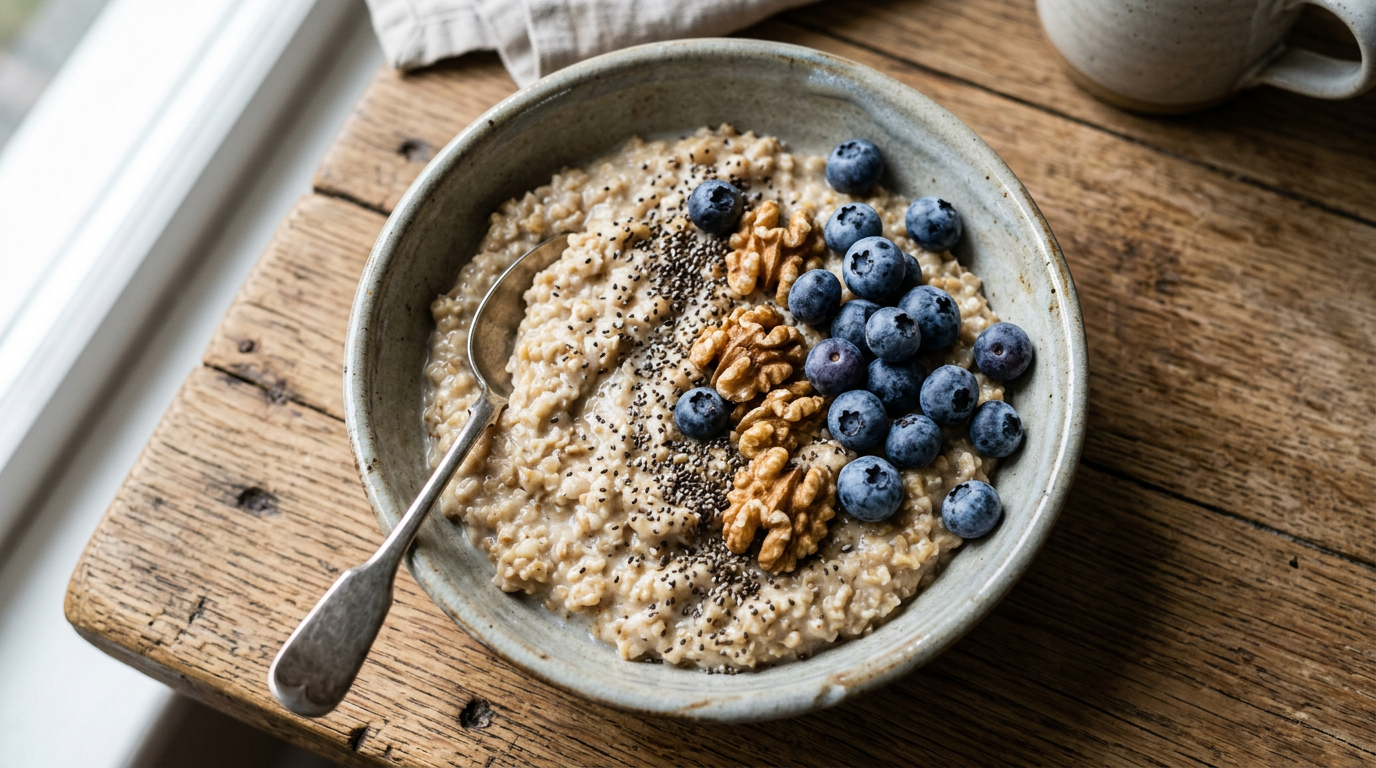
Healthy Fats: Specifically, a tablespoon of chia seeds, ground flaxseeds, or a handful of walnuts adds omega-3 fatty acids, which are crucial for brain health and reducing inflammation. Furthermore, the fat also contributes to satiety and slows carbohydrate absorption.
-
Antioxidant-Rich Spices and Fruits: Similarly, sprinkle on Ceylon cinnamon, which has been shown to help with blood sugar control.
Add a handful of low-glycemic berries like blueberries, raspberries, or blackberries for a potent dose of polyphenols and antioxidants that combat oxidative stress.
A Blueprint for a Longevity Breakfast
By integrating these principles, you can move from eating a generic breakfast to executing a precise nutritional strategy. The goal is to create a meal that supports stable blood sugar, nourishes the gut microbiome, lowers inflammation, and provides sustained energy—all key components of a robust Preventative Medicine protocol.
Imagine the biological cascade: The low-GI steel-cut oats prevent a morning insulin spike. The beta-glucan begins its work of binding cholesterol. The added protein and fat enhance satiety, keeping you full and focused until your next meal. The resistant starch, formed overnight, travels to your colon to feed the beneficial bacteria that produce anti-inflammatory compounds. The antioxidants from berries and cinnamon patrol for free radicals.
This isn’t just “oatmeal.” It’s a multi-pronged daily intervention for long-term health. While the latest Clinical Breakthroughs and advanced diagnostics are exciting, mastering the fundamentals of nutrition provides the foundation upon which all other longevity strategies are built. The humble oat, when properly understood and utilized, is one of the most accessible and effective tools in our arsenal.
Editorial Note: This article was independently researched and written based on current publicly available health information and does not represent the views of, and is not affiliated with, any external publication referenced.
References
1. Whitehead, A., Beck, E. J., Tosh, S., & Wolever, T. M. (2014). Cholesterol-lowering effects of oat β-glucan: a meta-analysis of randomized controlled trials. *The American Journal of Clinical Nutrition*, 100(6), 1413–1421. https://doi.org/10.3945/ajcn.114.086108
2. Hou, Q., Li, Y., Li, L., Cheng, G., Sun, X., Li, S., & Tian, H. (2015). The Metabolic Effects of Oats Intake in Patients with Type 2 Diabetes: A Systematic Review and Meta-Analysis. *Nutrients*, 7(12), 10369–10387. https://doi.org/10.3390/nu7125536
3. Birt, D. F., Boylston, T., Hendrich, S., Jane, J. L., Hollis, J., Li, L., McClelland, S., Moore, S., Phillips, G. J., Rowling, M., Schalinske, K., Scott, M. P., & Whitley, E. M. (2013). Resistant starch: promise for improving human health. *Advances in Nutrition*, 4(6), 587–601. https://doi.org/10.3945/an.113.004325