Is Cologuard Accurate? Understanding Results and Limits
Medical Disclaimer: Educational content only. Not medical advice. Consult your doctor for personal health decisions.
Is Cologuard Accurate? Understanding Results and Limits
Is Cologuard accurate? It can detect many colorectal cancers in eligible screening patients, but it can also miss cancers and precancerous growths or produce a positive result when neither is found. The original Cologuard detected 92.3% of colorectal cancers in its pivotal study; Cologuard Plus detected 95.3% in a separate study. Those percentages describe cancer detection—not the chance that a person with a positive result has cancer.[accessdata.fda][accessdata.fda]
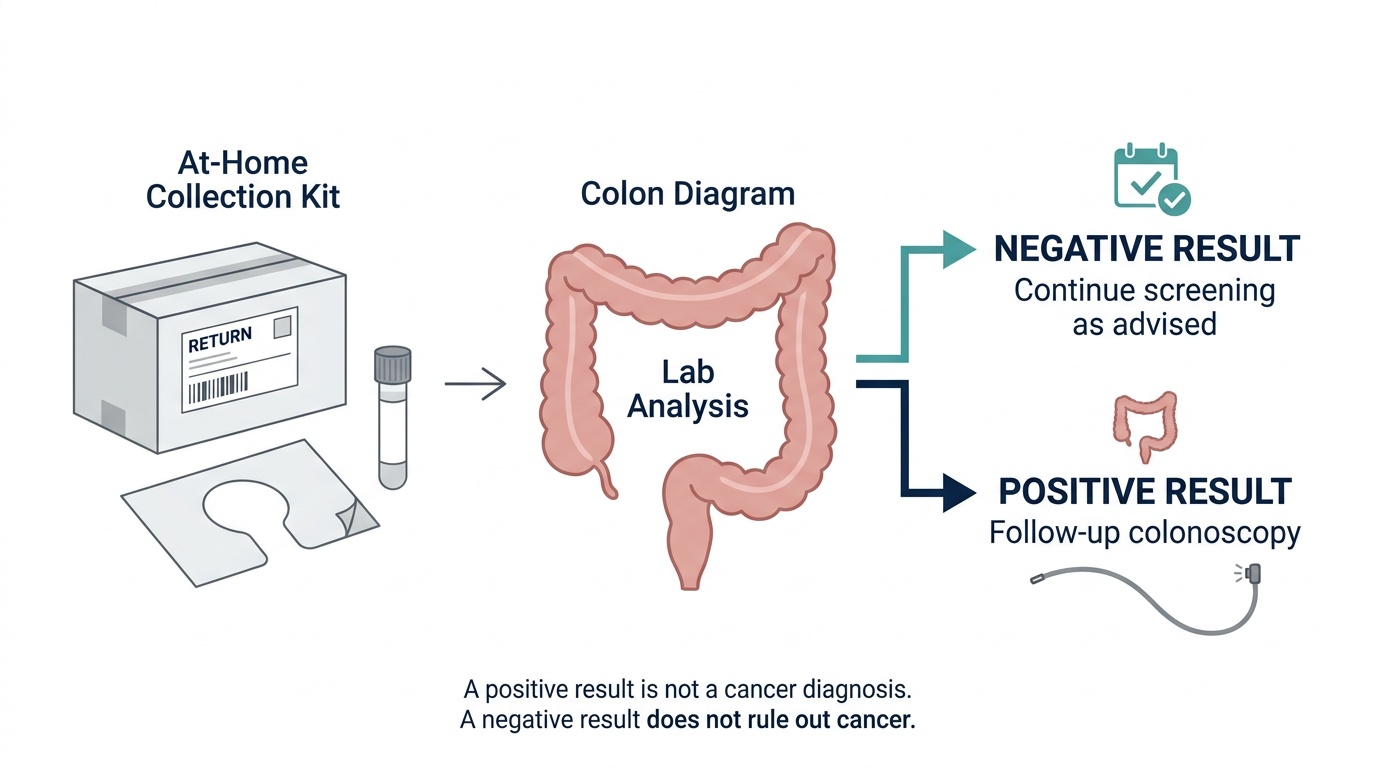
The practical takeaway is that Cologuard is a screening test, not a diagnosis. A positive result requires a colonoscopy, while a negative result does not rule out cancer or remove the need for future screening.[accessdata.fda][accessdata.fda]
Key Takeaways
- Cologuard and Cologuard Plus look for certain DNA markers and hidden blood in stool. They do not directly examine the colon.[accessdata.fda][accessdata.fda]
- Accuracy depends on what is being measured. Both tests detect colorectal cancer more often than advanced precancerous lesions.[accessdata.fda][accessdata.fda]
- A positive result does not establish a cancer diagnosis. Follow-up colonoscopy is necessary to determine what caused the abnormal screening result.[accessdata.fda]
- A negative result can miss disease. Continue screening as advised, and seek assessment for symptoms rather than relying on a previous negative test.[accessdata.fda][niddk.nih]
- Screening suitability and health needs differ from person to person. Discuss symptoms, family history, previous polyps, and test results with a qualified healthcare professional before deciding on a screening plan.[accessdata.fda][uspreventiveservicestaskforce]
What Does Cologuard Test For?
Cologuard is a prescription stool-based test used to screen for colorectal cancer—cancer of the colon or rectum. It combines testing for selected DNA changes with a test for hemoglobin, a protein in blood that may be present in stool.[accessdata.fda]
Some cancers and precancerous growths shed cells containing abnormal DNA into stool. They may also bleed. The laboratory combines these signals to produce a screening result, rather than identifying a growth’s exact location or confirming a diagnosis.[accessdata.fda][accessdata.fda]
Cologuard Plus is a different version with different DNA markers and its own clinical performance data. The FDA approved it in October 2024. Its results should not be mixed with figures from the original test.[accessdata.fda][accessdata.fda]
Is Cologuard Accurate? Understanding the Numbers
A single “accuracy percentage” can be misleading. Two measurements help explain how a screening test performs:
- Sensitivity describes how often the test correctly identifies people who have the condition being measured.
- Specificity describes how often the test correctly gives a negative result in people without the condition or conditions defined in the study.[accessdata.fda][accessdata.fda]
The distinction matters because detecting cancer, detecting precancer, and avoiding false alarms are different tasks.
Original Cologuard versus Cologuard Plus
| Study finding | Original Cologuard | Cologuard Plus |
| Sensitivity for colorectal cancer | 92.3% | 95.3% |
| Sensitivity for advanced precancer | 42.4% for advanced adenomas under the original study’s definition | 43.3% for advanced precancerous lesions under the Plus study’s definition |
| Specificity among participants without cancer or the study-defined advanced precancer | 86.6% | 90.7% |
These figures come from separate pivotal studies reviewed by the FDA. The studies used their own populations and lesion definitions, so this is not a head-to-head comparison between the two products.[accessdata.fda][accessdata.fda]
The cancer-detection figures also do not mean either test detects every polyp. In both studies, the tests missed a substantial proportion of advanced precancerous findings.[accessdata.fda][accessdata.fda]
Does 95.3% sensitivity mean a positive result is 95.3% likely to be cancer?
No. Sensitivity starts with people already known to have cancer and asks how many the test detected. It does not describe the probability of cancer after a positive screening result.[accessdata.fda]
For example, the FDA-hosted Cologuard Plus patient guide reports that, among people testing positive in its clinical study, approximately 3 out of 100 had colorectal cancer and 34 had advanced precancerous lesions. Others had nonadvanced adenomas or no neoplastic findings. These study results illustrate why a positive test needs investigation rather than being treated as a cancer diagnosis; they are not a personalized prediction.[accessdata.fda]
What Does a Positive Result Mean?
A positive result means the test detected a combination of signals associated with colorectal cancer or precancer. It cannot establish which finding is present. Some positive results are false positives, meaning follow-up colonoscopy does not find cancer or advanced precancer.[accessdata.fda]
Contact the clinician who ordered the test to arrange follow-up colonoscopy. Repeating a stool test is not a substitute for the colonoscopy needed after a positive screening result. The USPSTF states that follow-up colonoscopy is necessary for the benefits of stool-based screening to be achieved.[uspreventiveservicestaskforce]
During colonoscopy, a clinician examines the colon directly and can remove polyps or collect tissue samples when appropriate.[niddk.nih]
What Does a Negative Result Mean?
A negative result means the test did not detect enough of the targeted signals to produce a positive result. It does not guarantee that cancer or advanced precancer is absent.[accessdata.fda]
Continue participating in screening according to the plan agreed upon with your clinician. In its 2021 recommendation, the USPSTF lists stool DNA-FIT screening every one to three years, but the appropriate schedule should account for the specific test, current guidance, and your circumstances.[accessdata.fda][uspreventiveservicestaskforce]
A negative screening result also should not delay evaluation of symptoms. Screening is intended for people without symptoms; investigating bleeding, persistent bowel changes, or unexplained weight loss is a different clinical task.[niddk.nih][uspreventiveservicestaskforce]
Why Can False Results Happen?
False results are a recognized limitation of the tests, even when they are used correctly. Not every cancer or precancer produces a detectable combination of the markers being measured, and some people without the targeted findings still have a positive result.[accessdata.fda][accessdata.fda]
Collection conditions can also matter. The Cologuard Plus instructions say not to collect a sample during diarrhea or when blood may contaminate the sample, including menstrual bleeding or bleeding hemorrhoids. Unexpected rectal bleeding should be discussed with a healthcare professional rather than assumed to be an explanation for a positive result.[accessdata.fda]
Follow the instructions supplied with your particular kit, including collection, labeling, and return requirements. These instructions do not eliminate the possibility of a false result, but they help avoid preventable sample problems.[accessdata.fda]
Who Is an Appropriate Candidate?
In the United States, the USPSTF recommends colorectal cancer screening for average-risk adults ages 45 through 75 who do not have symptoms. For adults ages 76 through 85, the decision is individualized based on factors such as health, previous screening, and preferences.[uspreventiveservicestaskforce]
Cologuard Plus is FDA-approved for average-risk adults age 45 and older. It is not a replacement for diagnostic colonoscopy or surveillance colonoscopy in high-risk patients.[accessdata.fda]
Before choosing a stool DNA test, tell your clinician about:
- Previous colorectal cancer or polyps.
- Colorectal cancer in a parent, sibling, or child.
- Inflammatory bowel disease, including Crohn’s disease or ulcerative colitis.
- An inherited cancer syndrome, such as Lynch syndrome.
- A previous positive colorectal screening result.[accessdata.fda]
These details can change which test is appropriate. Product-specific eligibility rules also matter, so your clinician should review the instructions for the version being ordered.[accessdata.fda]
How Does It Compare With FIT and Colonoscopy?
A fecal immunochemical test, or FIT, checks stool for hidden blood. Cologuard adds DNA-marker testing. In the Cologuard Plus pivotal study, Plus detected more cancers and advanced precancerous lesions than the independent FIT used for comparison, but FIT produced fewer false-positive results among participants without those findings.[accessdata.fda]
Colonoscopy has a different role. It allows direct examination of the colon and can include polyp removal or biopsy. However, it requires bowel preparation and carries procedural risks, including bleeding and perforation—a tear in the bowel wall.[niddk.nih]
The choice is therefore not simply between an “accurate” test and an “inaccurate” one. Consider eligibility, testing frequency, preparation, access, and willingness to complete a colonoscopy if a stool test is positive.[uspreventiveservicestaskforce]
What the Evidence Does—and Does Not—Show
The pivotal accuracy studies assessed test performance at a single point in time, using colonoscopy findings as the reference. That is different from measuring how well an entire screening program works over many years.[accessdata.fda][accessdata.fda]
The FDA-hosted Cologuard Plus labeling specifically states that its benefits and risks with repeated testing over an established period had not been studied in the evidence supporting that labeling. Its single-test sensitivity should not be presented as proof that it is superior to every other screening strategy over a lifetime.[accessdata.fda]
Questions to Ask Your Healthcare Professional
- Am I at average risk, or does my history call for a different approach?
- Are you ordering the original Cologuard or Cologuard Plus?
- What would happen if my result were positive?
- When should I screen again after a negative result?
- Do any of my symptoms need diagnostic evaluation instead of screening?
- What are the benefits and limitations of FIT or colonoscopy for me?
When to Seek Medical Advice
For a positive Cologuard result without acute symptoms, contact the ordering clinician to arrange the recommended colonoscopy. The result needs follow-up, but it is not itself a cancer diagnosis.[accessdata.fda]
Seek prompt medical assessment for rectal bleeding, blood in stool, persistent changes in bowel habits, unexplained weight loss, or ongoing abdominal pain—even after a negative screening test. These symptoms can have several causes and do not, by themselves, prove cancer.[niddk.nih][niddk.nih]
Seek urgent care for black, tarry stools or other signs of acute gastrointestinal bleeding. Bleeding accompanied by fainting, confusion, severe dizziness, or signs of shock requires emergency help. In the United States, call 911 for a medical emergency; elsewhere, use your local emergency number.[niddk.nih]
FAQs
Can Cologuard miss cancer?
Yes. Both the original test and Cologuard Plus missed some cancers in their pivotal studies. A negative result reduces concern but cannot rule cancer out.[accessdata.fda][accessdata.fda]
Does a positive result mean I have cancer?
No. A positive result can reflect cancer, precancerous findings, or a false positive. Colonoscopy is needed to determine what is present.[accessdata.fda]
Can hemorrhoids affect the test?
Bleeding hemorrhoids are a reason not to collect a Cologuard Plus sample under its instructions. However, do not assume hemorrhoids explain an existing positive result or use that assumption to skip follow-up colonoscopy.[accessdata.fda]
Does Cologuard detect every precancerous polyp?
No. Its ability to detect advanced precancer is substantially lower than its ability to detect established colorectal cancer. It should not be described as a test that reliably excludes all polyps.[accessdata.fda][accessdata.fda]
Editorial Note
This article provides general health education and does not replace professional medical advice, diagnosis, or treatment. Individual symptoms, results, risks, and treatment needs vary. Discuss screening and follow-up decisions with a qualified healthcare professional who knows your medical history. No independent medical review of this article is claimed.
Sources
- U.S. Food and Drug Administration. “Summary of Safety and Effectiveness Data (SSED)” for Cologuard, PMA P130017. 2014.[accessdata.fda]
- U.S. Food and Drug Administration. “Summary of Safety and Effectiveness Data” for Cologuard Plus, PMA P230043. 2024.[accessdata.fda]
- Exact Sciences Corporation. “Cologuard Plus™ Instructions for Use.” December 2024. FDA-hosted labeling.[accessdata.fda]
- Exact Sciences Corporation. “Cologuard Plus™ Patient Guide.” December 2024. FDA-hosted labeling.[accessdata.fda]
- U.S. Preventive Services Task Force. “Colorectal Cancer: Screening.” 2021.[uspreventiveservicestaskforce]
- U.S. Preventive Services Task Force. “Clinician Summary: Colorectal Cancer: Screening.” 2021.[uspreventiveservicestaskforce]
- National Institute of Diabetes and Digestive and Kidney Diseases. “Colonoscopy.”[niddk.nih]
- National Institute of Diabetes and Digestive and Kidney Diseases. “Symptoms & Causes of Colon Polyps.”[niddk.nih]
- National Institute of Diabetes and Digestive and Kidney Diseases. “Symptoms & Causes of GI Bleeding.”[niddk.nih]