How to Know Your Body Fat Percentage: Methods Explained
Medical Disclaimer: Educational content only. Not medical advice. Consult your doctor for personal health decisions.
How to Know Your Body Fat Percentage: Methods and Accuracy
To learn how to know your body fat percentage, you can use a body-composition scale, have skinfold measurements taken by a trained professional, or arrange a specialized assessment such as a whole-body DXA scan. Each method estimates body fat differently, and none provides a perfectly exact answer for every person.[pmc.ncbi.nlm.nih]
The most useful choice depends on why you want the measurement. Tracking at home and evaluating a medical concern are different goals. Understanding a test’s limitations matters more than treating its result as a precise score of your health.[pmc.ncbi.nlm.nih][niddk.nih]
Key Takeaways
- Body fat percentage describes how much of your total weight comes from fat rather than fat-free tissues such as muscle, organs, water, and bone.[ncbi.nlm.nih]
- Home scales and skinfold measurements provide estimates. Device design, testing technique, and the equations used can affect accuracy.[pmc.ncbi.nlm.nih][mhealth.jmir]
- Whole-body DXA can assess fat mass, lean soft tissue, and bone mineral, but it also has measurement limitations.[pmc.ncbi.nlm.nih]
- BMI and waist circumference offer useful health information, but neither directly measures your body fat percentage.[niddk.nih][niddk.nih]
- Individual symptoms, results, and health needs differ. Discuss concerning findings or decisions about weight management with a qualified healthcare professional rather than relying on a body-fat reading alone.[niddk.nih]
What Does Body Fat Percentage Mean?
Body fat percentage is the proportion of your total body weight that is fat. The rest is classified as fat-free mass, which includes more than muscle: it also includes water, organs, connective tissue, and bone.[ncbi.nlm.nih]
The basic calculation is:
\text{Body fat percentage}=\frac{\text{Fat mass}}{\text{Total body mass}}\times100
For a hypothetical example, someone weighing 160 pounds with an estimated 40 pounds of fat would have an estimated body fat percentage of 25%. The calculation is straightforward; accurately estimating fat mass is the difficult part.
Body fat percentage also differs from fat distribution. Two people with similar percentages may store fat in different places. Extra fat around the abdomen can carry health risks that a total-body percentage does not fully describe.[niddk.nih]
How to Know Your Body Fat Percentage: Comparing the Methods
| Method | How it works | Main limitation |
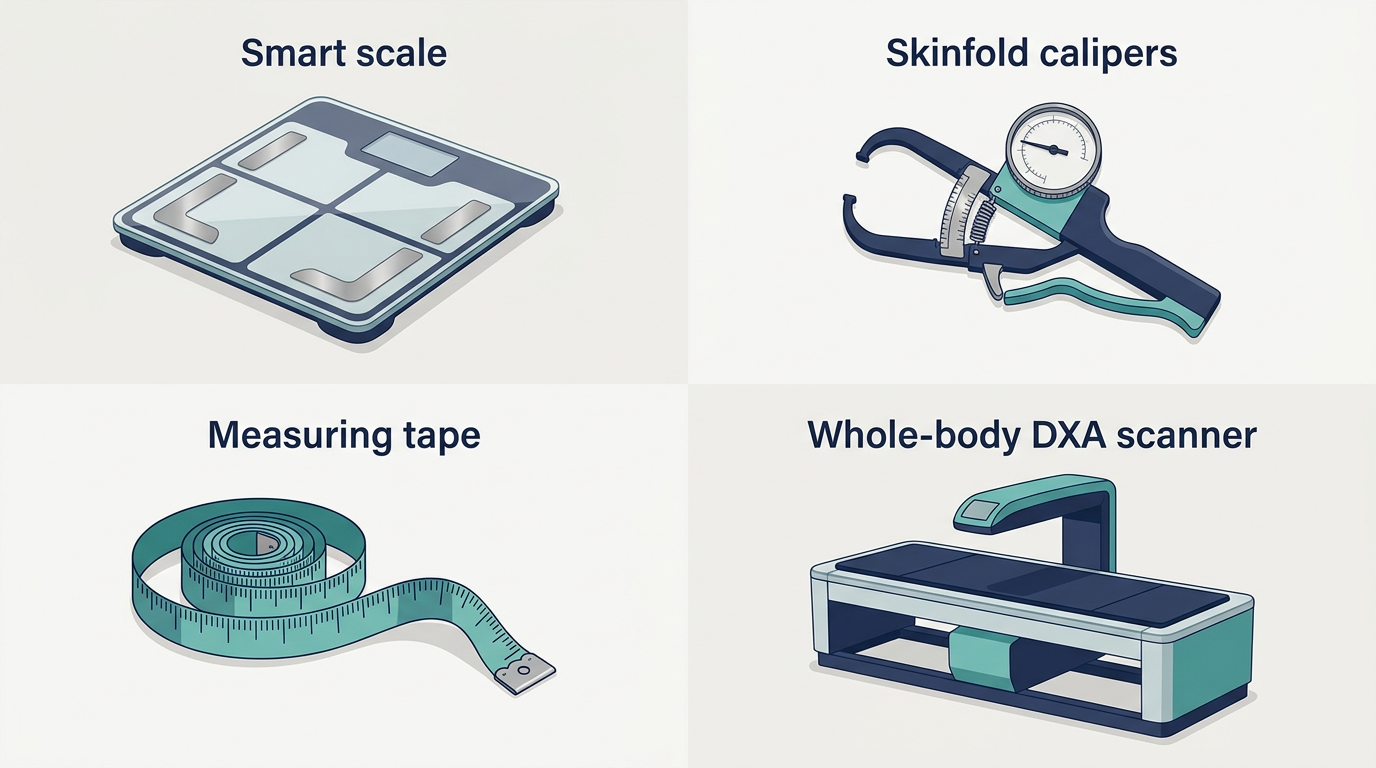
| Body-composition scale | Uses electrical resistance and a prediction equation to estimate body composition. | Results depend on the device, hydration, body characteristics, and testing conditions. [pmc.ncbi.nlm.nih][mhealth.jmir] |
| Skinfold calipers | Measures folds of skin and underlying fat at selected body sites. | Technique and the selected equation affect the estimate. [pmc.ncbi.nlm.nih] |
| Tape-measure calculator | Uses body measurements in a prediction equation. | It estimates rather than directly measures body fat, and the equation may not suit everyone. [pmc.ncbi.nlm.nih] |
| Whole-body DXA | Uses low-dose X-rays to distinguish fat, lean soft tissue, and bone mineral. | Equipment, software, positioning, and hydration can affect results. [pmc.ncbi.nlm.nih] |
| Air-displacement testing | Measures body volume in a chamber and combines it with weight to estimate body density and fat. | Results depend on assumptions about tissue density and proper testing procedures. [pmc.ncbi.nlm.nih] |
Body-composition scales
Many smart scales use bioelectrical impedance analysis, or BIA. A small electrical current passes through the body, and the device measures resistance to that current. It then combines the measurement with information such as height and weight to estimate fat-free mass and fat mass. It does not directly scan or count fat cells.[pmc.ncbi.nlm.nih][mhealth.jmir]
Water is important to this process. Because BIA calculations depend on assumptions about body water, changes in hydration can affect the estimate. Different devices may also use different equations, so their readings are not automatically interchangeable.[pmc.ncbi.nlm.nih]
A scale can measure body weight reasonably well while producing less accurate body-composition estimates. In a 2021 hospital-based observational study, three smart-scale models measured weight more accurately than fat and muscle mass when compared with DXA. The findings concerned those specific models and patients; they do not establish the accuracy of every smart scale available today.[mhealth.jmir]
Skinfold calipers
A trained examiner uses calipers to measure the thickness of skin and underlying subcutaneous fat—the fat beneath your skin—at several locations. An equation converts those measurements into an estimated body fat percentage.[pmc.ncbi.nlm.nih]
The result depends on choosing the correct sites, measuring consistently, and using an appropriate equation. Skinfold testing also becomes more difficult when a fold exceeds the caliper’s measurement range.[pmc.ncbi.nlm.nih]
For repeat assessments, using the same trained examiner and measurement protocol helps reduce avoidable differences. A home self-measurement should not be assumed equivalent to a professional assessment.[mdpi]
Tape-measure calculators
Some body-fat calculators use measurements such as waist, neck, and hip circumference alongside height. These are prediction tools, not direct measurements of fat tissue. Like other equation-based methods, their usefulness depends partly on how well the equation fits the person being assessed.[pmc.ncbi.nlm.nih]
A waist measurement can still provide useful information about abdominal fat and health risk without being converted into a body fat percentage. NIDDK emphasizes that waist size adds information that BMI alone may miss.[niddk.nih]
Whole-body DXA
DXA, also written DEXA, stands for dual-energy X-ray absorptiometry. For body-composition assessment, it uses differences in X-ray absorption to estimate fat mass, lean soft tissue, and bone mineral across the body.[pmc.ncbi.nlm.nih]
It can provide more detailed information than a home scale, including regional measurements. However, it is not error-free: scanner hardware, software, positioning, hydration, meals, and recent exercise can influence the assessment.[pmc.ncbi.nlm.nih]
A routine hip-and-spine bone-density scan is not the same examination as a whole-body body-composition assessment. When booking, confirm which service is being offered. Because DXA uses X-rays, tell the ordering clinician and imaging staff if you are pregnant or could be pregnant before testing.[pmc.ncbi.nlm.nih][radiologyinfo]
Air-displacement testing and underwater weighing
Air-displacement plethysmography, often associated with the BOD POD system, estimates body volume while you sit in a chamber. Underwater weighing estimates body density using measurements taken in water. Both use density-based calculations to estimate body fat.[pmc.ncbi.nlm.nih]
These methods are usually found in specialized facilities. They also rely on assumptions and careful procedures, so they should not be treated as perfectly exact alternatives.[pmc.ncbi.nlm.nih]
Which Method Is Most Accurate?
There is no single method that works best in every setting. The appropriate choice depends on the person, the question being asked, available equipment, and how much measurement uncertainty is acceptable.[pmc.ncbi.nlm.nih]
Whole-body DXA is widely used in clinical and research assessments, but that does not mean everyone needs a scan. For a medical concern, a clinician can help determine whether a body-composition measurement would change your care. For personal tracking, understanding the limitations of your chosen method may be more useful than repeatedly switching devices.[pmc.ncbi.nlm.nih][pmc.ncbi.nlm.nih]
It also helps to separate two concepts:
- Accuracy describes how closely a result agrees with an appropriate reference measurement.
- Repeatability describes how consistently a method gives similar results under similar conditions.
A device can produce consistent numbers without those numbers being close to the reference result. Repeated readings alone do not establish accuracy.[mhealth.jmir]
How to Make Repeat Measurements More Useful
Consistent preparation reduces some sources of measurement variation, although it cannot eliminate a device’s underlying limitations.[mhealth.jmir][pmc.ncbi.nlm.nih]
For follow-up measurements:
- Use the same method and, when possible, the same device or facility.
- Follow the device’s or testing center’s preparation instructions.
- Keep timing, recent meals, exercise, and hydration conditions as consistent as the protocol allows.
- For scales, enter your personal information correctly and follow the positioning instructions.
- Ask what size of change is large enough to exceed that method’s usual measurement variation.[mhealth.jmir][pmc.ncbi.nlm.nih]
Do not assume that a short-term change in a device’s body-fat reading represents an equivalent change in fat tissue. Hydration and testing conditions can influence the estimate.[pmc.ncbi.nlm.nih][pmc.ncbi.nlm.nih]
Can BMI Tell You Your Body Fat Percentage?
No. BMI—body mass index—is calculated from height and weight. It does not directly measure body fat or distinguish fat from muscle. A muscular person may therefore have a high BMI without having a high amount of body fat.[niddk.nih]
BMI and waist size remain useful parts of an assessment, but neither should be interpreted in isolation. NIDDK notes that some people with lower BMI and waist measurements still have weight-related health risks, while some people with higher measurements do not have the same risk profile.[niddk.nih]
What Should You Do With the Result?
Treat the result as one piece of information, not a diagnosis or a verdict on your fitness. Interpretation depends on the measurement method, your body characteristics, medical history, and the reason for testing.[pmc.ncbi.nlm.nih][niddk.nih]
Before pursuing a particular percentage, ask:
- Is this method appropriate for me?
- How much uncertainty is there in this result?
- Is the comparison range appropriate for my age and the test used?
- Would changing this number improve a health outcome that matters to me?
- Should we also consider waist size, blood pressure, blood tests, strength, or physical function?
A body-fat estimate should support a broader health discussion—not replace it.[niddk.nih]
When to Discuss Testing With a Healthcare Professional
Seek professional guidance if you want to use a result to make substantial changes to your diet, exercise, or weight-management plan. This is particularly important when a medical condition could affect hydration or body composition, because those changes can complicate interpretation.[pmc.ncbi.nlm.nih]
If a result is unexpected, ask whether it should be repeated under standardized conditions or checked with another appropriate method. A surprising home reading does not, by itself, establish a medical problem.[pmc.ncbi.nlm.nih][mhealth.jmir]
FAQs
Can you calculate body fat percentage from weight alone?
No. Weight alone cannot distinguish fat from muscle, water, bone, and other tissues. Estimating body fat requires additional measurements or assumptions.[pmc.ncbi.nlm.nih][ncbi.nlm.nih]
Why do my smart scale and DXA results disagree?
They use different measurement techniques and calculations. Hydration, device equations, body characteristics, and testing conditions can contribute to disagreement. Do not treat the difference as proof that your body changed between tests.[pmc.ncbi.nlm.nih][mhealth.jmir]
Does a bone-density scan automatically include body fat percentage?
No. Routine bone-density testing usually examines the hip and spine. A whole-body body-composition assessment is a different protocol, so confirm what your appointment includes.[pmc.ncbi.nlm.nih][radiologyinfo]
Can a home scale replace a clinical assessment?
A home scale provides estimates, not a complete medical evaluation. If body composition matters to a diagnosis or treatment decision, ask your clinician which assessment is appropriate rather than relying on a consumer device alone.[niddk.nih][mhealth.jmir]
Editorial Note
This article is for general education and does not replace professional medical advice, diagnosis, or treatment. Individual symptoms, results, risks, and treatment needs vary. Consult a qualified healthcare professional for advice based on your medical history and care goals. No independent medical review of this article is claimed.
Sources
- National Institute of Diabetes and Digestive and Kidney Diseases. “Am I at a Healthy Weight?”[niddk.nih]
- National Institute of Diabetes and Digestive and Kidney Diseases. “Talking with Your Patients about Weight.”[niddk.nih]
- “Body Composition Methods: Comparisons and Interpretation.” Published in the Journal of Diabetes Science and Technology and available through PubMed Central.[pmc.ncbi.nlm.nih]
- “Body composition measurements.” Available through PubMed Central. 2014.[ncbi.nlm.nih]
- “Body composition with dual energy X-ray absorptiometry: from basics to new tools.” Available through PubMed Central. 2020.[pmc.ncbi.nlm.nih]
- Frija-Masson J, et al. “Accuracy of Smart Scales on Weight and Body Composition: Observational Study.” JMIR mHealth and uHealth. 2021.[mhealth.jmir]
- “Come Back Skinfolds, All Is Forgiven: A Narrative Review of the Efficacy of Common Body Composition Methods in Applied Sports Practice.” Nutrients. 2021.[mdpi]
- RadiologyInfo.org, American College of Radiology and Radiological Society of North America. “Bone Density Scan (DEXA or DXA).”[radiologyinfo]