Next-Gen Stents: Types, Benefits, Risks & How They Work
By Maria Shafiq | Founder & Health Research Writer, The Veins Vercel | Oct 9, 2026
Medical Disclaimer: The information provided in this article is for educational and informational purposes only and does not constitute medical advice. Always consult a qualified healthcare provider regarding any medical condition or treatment.
Next-Gen Stents: How New Technology Improves Artery Health
Next-generation stents are newer devices used to hold narrowed arteries open after angioplasty. They aim to improve blood flow while reducing problems seen with older stents, such as scar-tissue growth, blood clots, and the need for long-term blood-thinner medicines.[eurointervention.pcronline][pmc.ncbi.nlm.nih]
Key Takeaways
- Stents are small mesh tubes placed in narrowed arteries to restore blood flow. They are commonly used in coronary artery disease and some peripheral artery conditions.[pmc.ncbi.nlm.nih]
- Modern drug-eluting stents release medicine that helps reduce scar tissue inside the artery. Ultra-thin strut designs may improve healing and lower the chance of target-lesion failure compared with older thin-strut devices.[pmc.ncbi.nlm.nih][ahajournals]
- Bioresorbable scaffolds are designed to support the artery temporarily and then gradually absorb. Early polymer scaffolds had higher rates of clotting and were withdrawn from some markets; newer magnesium-based scaffolds show more favorable registry results but still require careful patient selection.[nature][jacc][eurointervention.pcronline]
- Shorter dual antiplatelet therapy (DAPT) may be appropriate for some high-bleeding-risk patients after certain modern stents, but the duration must be decided by a cardiologist.[ahajournals][terumo-europe]
- Doctor recommendation: Never stop aspirin or another antiplatelet medicine on your own after a stent. Symptoms, artery size, clot risk, bleeding risk, diabetes, kidney function, and the type of stent all affect the right treatment plan. Ask your interventional cardiologist which stent type, imaging method, and medication schedule are appropriate for you.
What Is a Stent?
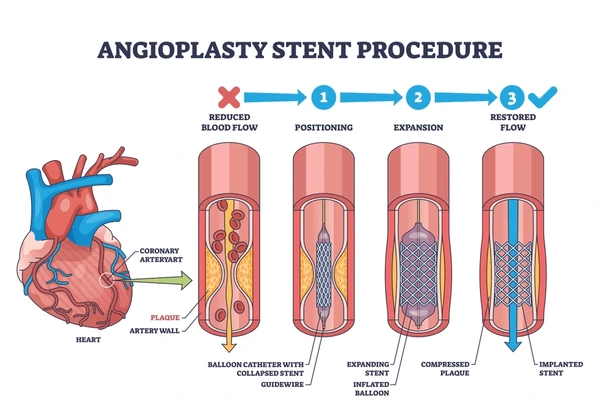
A stent is a small, expandable mesh tube placed inside a narrowed artery. During angioplasty, a doctor guides a thin tube through a blood vessel, inflates a balloon at the blockage, and usually places a stent to keep the artery open.
Stents are most often used for narrowed coronary arteries, which supply blood to the heart. They may also be used in other arteries, depending on the person’s condition and anatomy.
A stent can quickly improve blood flow, but it does not remove the underlying causes of artery disease. Cholesterol, high blood pressure, diabetes, smoking, inflammation, and lifestyle factors can still cause plaque to build up in other parts of the arteries.
How Stent Technology Has Changed
Bare-metal stents
Bare-metal stents were early devices made from metal mesh. They helped prevent an artery from closing again after balloon angioplasty, but scar tissue could grow inside the stent and narrow the artery again. This is called in-stent restenosis.
Drug-eluting stents
Drug-eluting stents (DES) have a medicine coating that slowly releases a drug to reduce scar-tissue formation. These devices greatly reduced restenosis compared with bare-metal stents and became standard care for many patients.[pmc.ncbi.nlm.nih]
Newer DES designs use thinner metal struts and biodegradable polymer coatings. Thinner struts may disturb blood flow less and may support better healing of the artery lining.[pmc.ncbi.nlm.nih][ahajournals]
Ultra-thin stents
Ultra-thin stents have very thin struts, often below about 70 micrometers. Research and meta-analyses suggest that ultra-thin strut stents can have lower target-lesion failure rates than some older thin-strut stents, although individual results vary by device and patient group.[pmc.ncbi.nlm.nih][ahajournals]
Bioresorbable scaffolds
Bioresorbable vascular scaffolds are designed to hold an artery open while it heals, then gradually break down and disappear. The idea is attractive because a permanent metal stent remains in the artery for life.
However, this technology has had setbacks. The first widely studied polymer scaffold, Absorb BVS, was associated with higher rates of scaffold thrombosis and heart attack compared with modern metallic drug-eluting stents, and it was later withdrawn from the market.[nature][jacc][pmc.ncbi.nlm.nih]
Newer magnesium-based scaffolds, such as Magmaris, use a different material and design. In the BIOSOLVE-IV registry, the 24-month target-lesion failure rate was 6.8%, mostly due to clinically driven repeat procedures; longer follow-up reported a 7.9% target-lesion failure rate at 36 months. These results are encouraging, but bioresorbable scaffolds are not automatically better than modern drug-eluting stents for every patient.[eurointervention.pcronline][biotronik]
Types of Next-Gen Stents
| Stent type | How it works | Main potential benefit | Important limitation |
| Bare-metal stent | Metal mesh keeps artery open | Simple, established device | Higher risk of scar-tissue narrowing |
| Drug-eluting stent | Releases medicine to limit scar tissue | Lower restenosis risk | Requires antiplatelet medicines |
| Ultra-thin DES | Uses thinner struts and often a biodegradable coating | May improve healing and reduce target-lesion failure | Benefits vary by device and anatomy |
| Polymer bioresorbable scaffold | Temporary polymer support that absorbs over time | May leave no permanent implant | Earlier versions had higher clot risk; Absorb BVS was withdrawn [nature][jacc] |
| Magnesium bioresorbable scaffold | Magnesium support gradually absorbs | Promising registry outcomes; temporary support | Requires precise placement and follow-up; long-term evidence still developing [eurointervention.pcronline][biotronik] |
How Next-Gen Stents May Improve Artery Health
1. Better blood flow
All stents aim to reopen a narrowed artery and restore blood flow. This can reduce symptoms such as chest pain caused by reduced blood supply to the heart.
2. Less scar tissue
Drug-eluting stents release medicine that limits excessive smooth-muscle growth inside the artery. This helps reduce the chance that the treated area narrows again.[pmc.ncbi.nlm.nih]
3. Thinner, more flexible designs
Ultra-thin struts may create less turbulence in blood flow and may allow the artery lining to heal more smoothly. Clinical studies and meta-analyses have found lower target-lesion failure rates with some ultra-thin devices, though not every study shows superiority.[pmc.ncbi.nlm.nih][ahajournals]
4. Temporary support
Bioresorbable scaffolds are designed to provide support during healing and then gradually disappear. In theory, this may allow the artery to move and expand more naturally after the device absorbs.
In practice, the first-generation polymer scaffolds did not perform as well as hoped. Their thicker struts and slower healing contributed to higher thrombosis rates, so careful deployment and patient selection are essential.[nature][pmc.ncbi.nlm.nih]
Do Next-Gen Stents Remove the Need for Blood Thinners?
No. After most stent procedures, patients need antiplatelet medicines to help prevent clots. This often includes aspirin plus a second medicine such as clopidogrel, ticagrelor, or prasugrel.
The needed duration depends on the stent, the reason for the procedure, bleeding risk, and whether the patient takes blood thinners for another condition. In the MASTER DAPT trial, one month of DAPT after certain bioresorbable-polymer drug-eluting stents reduced bleeding risk without increasing ischemic risk in selected high-bleeding-risk patients.[terumo-europe]
But this does not mean one month is right for everyone. Some patients need longer treatment, especially after a heart attack, with complex stent placement, or when they have a higher clot risk.
Benefits of Modern Stents
- Lower risk of repeat narrowing compared with older devices
- Better healing with thinner struts and improved drug coatings
- Potential for shorter blood-thinner courses in selected high-bleeding-risk patients
- Temporary support options with newer bioresorbable scaffolds
- Improved imaging and deployment techniques, including intravascular ultrasound (IVUS) and optical coherence tomography (OCT)
Risks and Limitations
Even advanced stents have risks. A stent does not cure atherosclerosis, and arteries can narrow again if plaque continues to build up.
Possible issues include:
- Blood clots in the stent: This is uncommon but serious and can cause a heart attack.
- Restenosis: Scar tissue can still grow inside or around the stent.
- Bleeding: Antiplatelet medicines lower clot risk but increase bleeding risk.
- Scaffold thrombosis: Bioresorbable scaffolds may have a higher clot risk if they are poorly sized, underexpanded, or if antiplatelet medicines are stopped too soon.[nature][pmc.ncbi.nlm.nih][eurointervention.pcronline]
- Complex anatomy: Heavily calcified arteries, small vessels, and certain blockages may not be suitable for every stent type.
- Cost and availability: Newer devices and imaging guidance can cost more and may not be available everywhere.
Who May Benefit From a Next-Gen Stent?
A next-generation stent may be considered for people who need angioplasty for a significant artery blockage. The best option depends on:
- The location and length of the blockage
- Artery size and amount of calcium
- Whether the patient has diabetes or kidney disease
- Bleeding risk and need for other blood thinners
- Whether the procedure is emergency or planned
- Heart function and overall health
There is no single “best stent” for everyone. A modern drug-eluting stent remains the usual choice for many patients, while bioresorbable scaffolds may be considered in selected cases by experienced teams.[nature][eurointervention.pcronline][pmc.ncbi.nlm.nih]
Questions to Ask Your Cardiologist
- What type of stent are you recommending, and why?
- Is a drug-eluting stent or bioresorbable scaffold better for my artery?
- Will you use IVUS or OCT imaging during the procedure?
- How long will I need aspirin and my second antiplatelet medicine?
- What are my specific risks of clotting, bleeding, and repeat narrowing?
- What lifestyle changes and medicines will help protect my other arteries?
- What warning symptoms should I report after the procedure?
How to Protect Your Arteries After a Stent
A stent treats a narrowed section of artery, but it does not stop artery disease throughout the body. Long-term heart health still depends on daily habits and medical follow-up.
- Take prescribed medicines exactly as directed
- Do not stop antiplatelet medicines without medical advice
- Control blood pressure, cholesterol, and blood sugar
- Avoid smoking and vaping
- Eat a balanced, heart-healthy diet
- Stay active as advised by your care team
- Attend all follow-up appointments
- Seek urgent help for chest pain, shortness of breath, fainting, or stroke-like symptoms
Frequently Asked Questions
What are next-gen stents?
Next-gen stents are newer artery stents designed to improve healing and reduce complications. They include ultra-thin drug-eluting stents, biodegradable-polymer stents, and bioresorbable scaffolds.[eurointervention.pcronline][pmc.ncbi.nlm.nih]
Do bioresorbable stents dissolve completely?
They are designed to be absorbed over time. However, early polymer scaffolds had safety problems, and not all bioresorbable devices are available or appropriate today. Newer magnesium scaffolds are showing better registry outcomes, but long-term evidence is still developing.[nature][jacc][eurointervention.pcronline]
Are next-gen stents better than older stents?
Often, yes—but not in every case. Ultra-thin and biodegradable-polymer drug-eluting stents have improved outcomes for many patients, while bioresorbable scaffolds require more careful selection and follow-up.[nature][pmc.ncbi.nlm.nih][ahajournals]
Can an artery block again after a stent?
Yes. Modern stents lower the risk, but restenosis and new plaque buildup can still occur. Medicines, lifestyle changes, and regular follow-up remain important.
Do stents cure heart disease?
No. A stent opens a specific narrowed artery. It does not cure the widespread process of atherosclerosis, so ongoing prevention and medication are still necessary.
Conclusion
Next-generation stents represent meaningful progress in artery care. Ultra-thin drug-eluting stents and improved biodegradable coatings may support better healing and lower the risk of repeat procedures, while newer bioresorbable scaffolds aim to provide temporary support before being absorbed.[eurointervention.pcronline][pmc.ncbi.nlm.nih][ahajournals]
Still, stent technology is not a cure for cardiovascular disease. The safest results come from choosing the right device for the right patient, using careful imaging and technique, following the prescribed medication plan, and managing long-term risk factors such as cholesterol, blood pressure, diabetes, and smoking.
Medical disclaimer: This article is for general education only and is not personal medical advice. Symptoms and treatment needs differ from person to person. Always consult a licensed cardiologist, vascular specialist, or emergency clinician about diagnosis and treatment.
Editorial note: This article was independently researched and written using publicly available health information. It is not affiliated with, and does not represent the views of, any external publication, device manufacturer, or research group referenced below.
References
- Circulation: Cardiovascular Interventions. Comparison of Ultrathin- Versus Thin-Strut Stents in Patients With Coronary Artery Disease. https://www.ahajournals.org/doi/10.1161/CIRCINTERVENTIONS.123.014042
- EuroIntervention. One- and two-year clinical outcomes of treatment with resorbable magnesium scaffolds: the BIOSOLVE-IV registry. https://eurointervention.pcronline.com/article/one-and-two-year-clinical-outcomes-of-treatment-with-resorbable-magnesium-scaffolds-for-coronary-artery-disease-the-prospective-international-multicentre-biosolve-iv-registry
- Nature Reviews Cardiology. Fully bioresorbable vascular scaffolds: lessons learned and future directions. https://www.nature.com/articles/s41569-018-0124-7
- JACC: Cardiovascular Interventions. Absorb Bioresorbable Vascular Scaffold: A Little Too Late. https://www.jacc.org/doi/10.1016/j.jcin.2024.11.002
- National Center for Biotechnology Information. Bioresorbable Scaffolds: Contemporary Status and Future Perspectives. https://pmc.ncbi.nlm.nih.gov/articles/PMC7733966/
- EuroIntervention. Safety and performance of a resorbable magnesium scaffold under real-world conditions: 12-month outcomes of the first 400 patients in BIOSOLVE-IV. https://eurointervention.pcronline.com/article/safety-and-performance-of-a-resorbable-magnesium-scaffold-under-real-world-conditions-12-month-outcomes-of-the-first-400-patients-enrolled-in-the-biosolve-iv-registry
- Terumo. MASTER DAPT Study: Short-duration dual antiplatelet therapy after stenting in high-bleeding-risk patients. https://www.terumo-europe.com/en/interventional-systems/clinical-evidence/view-all-clinical-resources/clinical-reviews/master-dapt-study
- Biotronik. 36-Month Outcomes of the BIOSOLVE-IV Registry. https://www.biotronik.com/freesolve/files/36-Month%20Outcomes%20of%20the%20BIOSOLVE-IV%20Registry_presented%20at%20TCT.pdf