Introduction
In ultra-modern, dynamic schoolrooms, educators strive to teach more than just facts—they aim to nurture essential thinkers and effective communicators. That’s where the Claim-Evidence-Reasoning (CER) framework is available.. If you’ve ever puzzled over how to assist college students who no longer simply answer a question but justify their solution scientifically, this effective device is for you. CER offers an easy but based way to elevate student wondering, align with standards, and make technology learning significant and real.
What is the CER Framework?
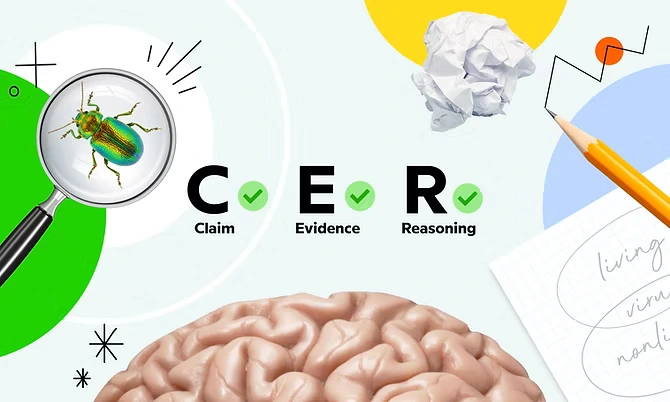
Breaking Down the Acronym C-E-R stands for:
- Claim: An assertion or conclusion that answers the original query.
- Evidence: Scientific statistics that help declare.
- Reasoning: A justification that connects the evidence to declare the usage of scientific concepts.
This 3-part structure pushes college students to no longer only comprehend scientific ideas but also explain their wonder in depth.
Origin and Relevance in Classrooms
CER emerged from the technological know-how schooling network’s need to assist college students engage in scientific argumentation—a talent emphasized in the Next Generation Science Standards (NGSS). As science moved from rote memorization to inquiry-based learning, educators wished for a way to guide students in questioning and writing like scientists.
Why CER Matters in Science Education
Promotes Critical Thinking
In a world full of incorrect information, college students want the capacity to significantly compare statistics. Claim-Evidence-Reasoning encourages deeper questioning and ensures that scholars can return to their thoughts with information.
Encourages Scientific Communication
CER allows students to explain their reasoning in a clear, understandable manner. Whether they’re discussing the water cycle or genetics, students use clean language and good judgment.
Aligns with NGSS and twenty-first-century Skills
The NGSS emphasizes inquiry, clarification, and justification. CER flawlessly fits that version. It additionally builds twenty-first-century talents like verbal exchange, collaboration, and problem-solving.
Components of the CER Framework Explained
The “Claim” declaration is a simple, concise assertion that solves a question or draws a conclusion based on research.
“Plants expand faster during the day than in the dark.”
Good claims are clear, arguable, and primarily based on records.
The “Evidence”
Evidence is the genuine basis for the declaration. It can include:
Observations
- Data from experiments
- Scientific literature
Example:
“The plant in sunlight grew 5 cm per week, whilst the one in darkness grew simplest 1 cm.”
Quality proof is relevant, correct, and sufficient.
The “Reasoning”
This is the “why” behind the solution.. Reasoning hyperlinks the proof to the declare using scientific standards.
Example:
“Plants need sunlight to carry out photosynthesis, which affords electricity for growth.”
This step often challenges college students the most, is where real learning takes place.
Claim-Evidence-Reasoning Examples Real-World Science Examples
Middle School CER Example
Question:
Do colder temperatures slow down yeast fermentation?
Claim:
Yes, yeast ferments more slowly in cold temperatures.
Evidence: Yeast inside the refrigerator produced fewer bubbles than yeast at room temperature.
Reasoning: Low temperatures sluggish down enzyme activity, reducing the rate of fermentation
High School CER Example
Question: Does growing carbon dioxide affect plant growth?
Claim: Yes, higher CO2 levels growth plant growth.
Evidence: Plants in a CO2-rich chamber grew 30% taller than those in everyday air.
Reasoning: CO2 is a key aspect of photosynthesis, so more CO2 enhances the process.
Examples in Other Subjects
Though constructed for science, CER works in other regions too:
History: “The important purpose of the Civil War was into slavery. Evidence: Economic and political files, Reasoning: Explain the divide between North and South.
English: “The individual is selfish.”
Evidence: Actions inside the text, Reasoning: Behavior continuously benefits the person over others.
Implementing CER in the ClassroomLesson Planning Strategies
When introducing declare-evidence-reasoning (CER) to college students, it’s important to accomplish that in a way that is age-appropriate and scaffolded. Start with question that might be attractive and accessible.
- Use relatable phenomena: For example, “Why do ice cubes melt faster on metal than on plastic?
- Pose questions based on recent experiments: Use actual schoolroom activities to generate dialogue and evaluation.
- Planning instructions round CER ensures that students don’t just memorize information but can follow it meaningfully.
Scaffolded Learning and CER Practice
It’s exceptional to construct CER competencies step by step:
Step 1:
Start with simply the “Claim.” Encourage students to form opinions and predictions.
Step 2:
Introduce “Evidence”, the usage of lab effects, videos, or datasets.
Step 3:
Add “Reasoning” once students understand the relationship between facts and conclusions.
Reinforcement through repetition, discussion, and feedback strengthens information. Teachers regularly use sentence starters or prompts like:
“My claim is…”
“I know this because…”
“These topics because…”
Using Graphic Organizers and Sentence Starters
Graphic organizers may be effective tools to help college students put together their thoughts in advance of writing.. A primary CER chart with three columns—Claim, Evidence, Reasoning—can help manual college students step by step.
Example of an easy CER organizer:
- Claim
- Evidence
- Reasoning
Statement answering the question
- Observations or data gathered
- Explanation connecting the evidence to the claim
- These supports are mainly useful for ESL students or beginners with processing challenges.
Assessing CER Responses, Rubrics, and Feedback
Assessment is how CER will become both a teaching and learning opportunity. A desirable CER rubric normally consists of:
- Clarity of the Claim
- Relevance and Sufficiency of Evidence
- Depth of Reasoning
- Use of Scientific Vocabulary
- Logical Flow and Organization
Use feedback for manual improvement:
- “Great proof! Try connecting it immediately in your declaration.”
- “Your declaration is strong—can you explain why the proof helps it?”
Common Student Challenges and Solutions
1. Too vague claims:
Encourage college students to be unique and concise.
2 . Irrelevant or weak evidence:
Teach how to identify credible data.
3 . Missing or fallacious reasoning:
Provide fashion and exercise examples of sturdy reasoning.
By figuring out these issues early, teachers can adjust their preparation and offer a tailored guide.
Claim-Evidence-Reasoning Across Grade Levels
1) Adapting CER for Younger Students
Elementary students can grasp CER while it’s simplified. For younger newcomers:
- Use photographs and drawings as evidence.
- Guide college students verbally via their reasoning.
- Use simplified language like “I suppose… Because…”
Even first graders can begin getting to know how to justify their ideas, which lays a strong basis for future scientific reasoning.
2) Advanced Uses in High School and Beyond
In high school, CER can assist with lab reviews, clinical essays, and debates. Advanced college students can be asked to:
- Compare more than one portion of proof
- Address counterclaims
- Cite assets for he usage of educational conventions.
C-E-R additionally prepares students for standardized tests, studies assignments, and university-degree writing.
3) CER vs. Other Argumentation Models
How CER Differs from Traditional Essays
- Unlike 5-paragraph essays, CER is focused on concise, proof-based total reasoning. It’s no longer about writing length—it’s approximately logical progression.
- Traditional essays frequently emphasize structure and literary style.
- CER is a specialty of argument excellence, making it best for science and inquiry-based topics.
Benefits of Using CER Over Other Models
- Clear and easy layout: Easy for students to bear in mind
- Emphasizes proof-based questioning
- Supports STEM training desires
- Fosters independence and self-belief in reasoning
Whether you’re teaching biology or chemistry, declare-evidence-reasoning is a streamlined way to teach argumentation in an authentic context.
Technology Tools to Enhance CER Learning
Digital Platforms for Student Collaboration
Many tools make claim, evidence, and reasoning activities interactive:
Google Docs or Padlet: for collaborative CER writing
Flipgrid: for students to file and proportion verbal CERs
Edmodo or Seesaw: to tune scholar development and deliver feedback
These systems grow scholar engagement and provide possibilities for peer assessment.
AI and CER Practice Tools
Emerging AI equipment can help college students generate pattern CERs or evaluate drafts for clarity. While AI shouldn’t replace scholarly questioning, it is able to serve as an aid, especially for English language learners or college students with unique needs.
Claim Evidence Commentary vs. CER
How These Models Compare
Claim-Evidence-Commentary (CEC) is commonly used in English Language Arts. While similar to CER, it places more emphasis on the emotional or thematic analysis, rather than scientific logic.
| Feature | CER | CEC (Commentary) |
| Focus | Scientific reasoning | Literary/textual analysis |
| Evidence Type | Data, observations, experiments | Text quotes, literary elements |
| Reasoning/Commentary | Scientific principle-based | Personal or analytical reflection |
Choosing the Right Framework
- Use CER for technology and records-primarily based arguments.
- Use CEC while interpreting literature, studying poetry, or writing essays.
- Understanding and a way to use each other empower teachers and students to speak honestly about any problem.
Tips for Teachers New to CER
Starting Small
If you’re introducing claim proof reasoning:
- Begin with entire-magnificence examples
- Model your questioning
- Use visual aids and anchor charts.
Start with quick, low-stakes assignments earlier than moving to complete paragraphs or essays.
Encouraging Peer Review and Collaboration
Let college students study each other’s CERs. Peer enhancing builds confidence and teaches the way to critique respectfully. Consider the use of organizational sports like
- CER writing stations
- Group presentations
- CER debates
The more students engage with different reasoning, the better they’ll internalize the process.
Final Thoughts
The claim-evidence-reasoning (CER) framework is greater than just an educational method—it’s a pathway to deeper knowledge, important questioning, and real-world problem-solving. Whether you’re a veteran science instructor or just starting, integrating claim-proof reasoning into your training will transform your study room into a hub of inquiry and perception.
As students learn how to make sturdy claims, guide them with evidence, and justify their thinking, they build the analytical abilities they’ll need not only in technological know-how but also in existence.
FAQs
Q1) What is the CER method in science?
CER stands for Claim-Evidence-Reasoning. It’s a structured way for students to construct scientific causes with the aid of pointing out a claim, supporting it with evidence, and justifying it with clinical reasoning.
Q2) Can CER be utilized in topics other than science?
Yes! While designed for science, it can also be utilized in records, ELA, and social studies to guide evidence-based writing.
Q3) What’s a good CER, proof-based, and reasoning instance?
Claim: Plants grow faster with extra daylight.
Evidence: Plant A (with greater sunlight) grew 10 cm every week; Plant B only 5 cm.
Reasoning: Sunlight aids photosynthesis, which produces the strength flowers need to develop.
Q4) How is CER unique from a claim proof statement?
CEC (utilized in ELA) focuses on literary analysis and interpretation. CER (utilized in science) emphasizes fact-based, data-based reasoning.
Q5) How can instructors assist college students to get better at CER?
Provide fashions, use graphic organizers, give well-timed feedback, and practice regularly in special contexts.
Disclaimer:
This content is intended for educational purposes to support teaching and learning in science. It is not a substitute for professional instructional design or curriculum development advice. Educators should adapt the framework as appropriate for their specific educational context.
This summary is based on authoritative educational resources outlining the CER framework’s definition, practical use, and benefits in science classrooms to foster deeper understanding and engagement.